
introduction
In the morning, tearing open a bag of individually packaged coffee powder; in the afternoon, taking out a box of properly preserved fruit slices from the refrigerator; in the evening, unpacking the corrugated cardboard box delivered by online shopping - behind these seemingly ordinary life scenarios, there is a key material "shadow" active: polyvinyl alcohol (PVA) coating material.
In the morning, tearing open a bag of individually packaged coffee powder; in the afternoon, taking out a box of properly preserved fruit slices from the refrigerator; in the evening, unpacking the corrugated cardboard box delivered by online shopping - behind these seemingly ordinary life scenarios, there is a key material "shadow" active: polyvinyl alcohol (PVA) coating material.
As the "invisible champion" of the packaging industry, PVA coating technology is quietly revolutionizing our daily lives. This article will take you on an in-depth exploration of this material technology that is changing the rules of the packaging industry. From what is PVA, why use PVA, and what to pay attention to when coating PVA, it reveals how PVA builds an innovative bridge between environmental protection and functionality.
What is PVA
Polyvinyl alcohol (PVA), as a fully synthetic water-soluble polymer, possesses a unique "hydrophilic character" due to the densely packed hydroxyl groups on its molecular chain. This seemingly contradictory property—starting from hydrophobic vinyl monomers but forming a hydrophilic polymer—is precisely where the magic of PVA technology lies. In industrial applications, PVA products are finely categorized based on two dimensions:
Polyvinyl alcohol (PVA), as a fully synthetic water-soluble polymer, possesses a unique "hydrophilic character" due to the densely packed hydroxyl groups on its molecular chain. This seemingly contradictory property—starting from hydrophobic vinyl monomers but forming a hydrophilic polymer—is precisely where the magic of PVA technology lies. In industrial applications, PVA products are finely categorized based on two dimensions:
polymerization degree, including low polymerization degree (DP<1000), medium polymerization degree (1000<DP<2000), and high polymerization degree (DP>2000);
and alcoholysis degree, including low alcoholysis degree (<80%), partial alcoholysis (79-89%), medium alcoholysis (91-98%), and complete alcoholysis (98-99%).
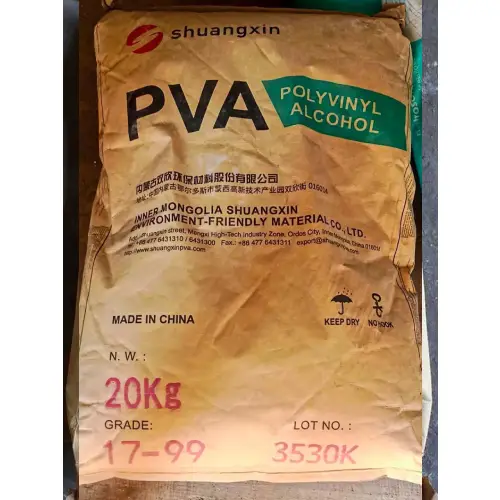
This multi-level classification system enables PVA to precisely match the needs of different application scenarios. In the coating industry, commonly used PVA models include 1799, 2099, 2299, etc. The "17" and "22" represent the polymerization degree, while "99" indicates an alcoholysis degree of up to 99%. Coatings formed from such high alcoholysis PVA exhibit excellent barrier properties and mechanical strength.
When PVA molecules dissolve in water, the hydroxyl groups form a hydrogen bond network with water molecules, transforming PVA into a transparent viscous colloidal solution. This characteristic makes it an ideal carrier for coating processes. In solution form, PVA molecules can spread evenly on the substrate surface, forming a continuous and dense film after drying, thereby exerting its core functions.
Reasons for using PVA in the industry
03 in today's increasingly stringent environmental regulations, PVA stands out by virtue of its unique degradability. . However, the environmental performance is only the beginning of the story. The core value of PVA coating is more reflected in its multi-functional integration characteristics:
03 in today's increasingly stringent environmental regulations, PVA stands out by virtue of its unique degradability. . However, the environmental performance is only the beginning of the story. The core value of PVA coating is more reflected in its multi-functional integration characteristics:
PVA molecules are full of groups (hydroxyl groups) that like to "hold hands" with each other, and they will form an extremely dense "net" by holding hands in a dry state. . Especially when the molecules are arranged neatly (crystallized), the effect is better.
(2) PVA (polyvinyl alcohol) material with adjustable mechanical properties can adjust its hardness, elasticity and strength as "plasticine". The key is that its molecular structure is like a long chain full of "small hooks" (hydroxyl, -oh). These "little hooks" especially like to hold hands with each other (forming hydrogen bonds), and we can control the tightness and mode of their "holding hands" through some methods, so as to change the properties of the material. For example, by adding nanoparticles, the density of hydrogen bond network increases and the rigidity of materials is improved; Plasticizers can also be added to reduce intermolecular hydrogen bonds, thereby improving ductility and transparency.
(3) The composite compatible PVA coating exhibits excellent adhesion to various substrates.
Research has shown that modified PVA coating solution can directly form stable coatings on the surfaces of plastic films such as PET, BOPP, PE, etc., without the need for complex surface treatment processes. This' friendly personality 'makes PVA an ideal intermediate layer for composite materials.
(4) Function Expansion Platform
The hydroxyl groups in PVA molecules act as "chemical handles" and can be modified through esterification, cross-linking, blending, and other methods to introduce new functions. Adding nano titanium dioxide can enhance water resistance; Composite organic acids can enhance moisture resistance; Integrating antibacterial agents can achieve antibacterial function - the multifunctionality of PVA provides a broad platform for packaging innovation.
The hydroxyl groups in PVA molecules act as "chemical handles" and can be modified through esterification, cross-linking, blending, and other methods to introduce new functions. Adding nano titanium dioxide can enhance water resistance; Composite organic acids can enhance moisture resistance; Integrating antibacterial agents can achieve antibacterial function - the multifunctionality of PVA provides a broad platform for packaging innovation.
Key parameters of PVA coating process
(1) Formula system: The precise and balanced artistic typical high barrier PVA coating liquid formula contains a precise ratio of 10-15% PVA solids and 85-90% water, and adds various functional additives based on PVA quality: 25-28% plasticizers (glycerol, polyethylene glycol), 3-5% emulsifiers (such as amide propyl betaine), 5-7% anti adhesive agent (caprolactam), and 1-3% release agent (Tween-80).
(2) Dispersion grinding: The preparation of breakthrough solutions at the nanoscale requires a rigorous dispersion procedure: a high shear disperser is used to process at a speed of 1500-2000 revolutions per minute for 0.5-1 hour, followed by grinding in a sand mill to a particle size of less than 100 nanometers. This process returns inorganic additives (such as titanium dioxide) to their original particle size, significantly improving the density and self leveling performance of the coating.
(3) Coating equipment: The precision transfer art coating process adopts a specially designed mesh roller with an "eight" shaped opening design, with a mesh to wall ratio controlled between 10:1 and 15:1, and a mesh size of 100-500. These parameters together ensure that the coating is evenly transferred to the substrate surface with a precision coating amount of 3-10g/m ². The speed of the coating machine needs to be stably controlled within the range of 20-300/min to achieve a perfect balance between efficiency and quality.
(4) Drying and solidification: shaping of microstructure
The coated material needs to be accurately dried in a hot air environment of 105-115 ℃. This stage not only removes moisture, but also promotes the orientation crystallization and cross-linking reaction of PVA molecular chains, forming a stable three-dimensional network structure. The temperature control accuracy of ± 2 ℃ is crucial, as too low a temperature can cause residual moisture to affect the barrier properties; If it is too high, it will cause thermal degradation
Common problems and solutions
(1) Analysis of reasons for uneven coating (horizontal stripes): changes in viscosity of the slurry (caused by solvent evaporation), clogging of the mesh roller, and deviation in parallelism of the back roller
Solution:
▶ Install online viscometer for real-time monitoring and replenish volatile solvents
▶ Adopting the "outer eight character" baffle design to eliminate bulging edges
▶ Regularly calibrate the parallelism of the back roller (error ≤ 0.01mm/m)
Solution:
▶ Install online viscometer for real-time monitoring and replenish volatile solvents
▶ Adopting the "outer eight character" baffle design to eliminate bulging edges
▶ Regularly calibrate the parallelism of the back roller (error ≤ 0.01mm/m)
(2) Analysis of surface defects (scratches/particles): Agglomerated particles in the slurry (not fully dispersed), small gaps in the scraper, and environmental dust pollution
Solution:
▶ Implement two-stage filtration (100 μ m+50 μ m filter combination)
▶ Using sapphire material scraper, regularly inspect the blade edge under a microscope
▶ Improve the cleanliness standards of the coating workshop
Solution:
▶ Implement two-stage filtration (100 μ m+50 μ m filter combination)
▶ Using sapphire material scraper, regularly inspect the blade edge under a microscope
▶ Improve the cleanliness standards of the coating workshop
(3) Cause analysis of powder loss problem (coating powdering): caused by over drying (thermal degradation), low environmental humidity, and insufficient water absorption of the substrate
Solution:
▶ Adopting segmented drying: 90 ℃ (pre drying) → 110 ℃ (main drying) → 80 ℃ (rewetting)
▶ Workshop humidity control within the range of 50 ± 5% RH
▶ Substrate pretreatment (corona treatment to enhance wettability)
Solution:
▶ Adopting segmented drying: 90 ℃ (pre drying) → 110 ℃ (main drying) → 80 ℃ (rewetting)
▶ Workshop humidity control within the range of 50 ± 5% RH
▶ Substrate pretreatment (corona treatment to enhance wettability)
(4) Analysis of reasons for insufficient adhesion: insufficient surface tension of the substrate, high crystallinity of PVA, and fast drying rate
Solution:
▶ Base material corona treatment (dyn value ≥ 40mN/m)
▶ Add 0.5-1% polyethylene glycol 400 to reduce crystallinity
▶ Using infrared preheating substrate (60 ℃) to enhance interface bonding
Solution:
▶ Base material corona treatment (dyn value ≥ 40mN/m)
▶ Add 0.5-1% polyethylene glycol 400 to reduce crystallinity
▶ Using infrared preheating substrate (60 ℃) to enhance interface bonding
(5) Analysis of Reasons for Insufficient Water Resistance: Exposure of PVA Hydrophilic Groups, Insufficient Crosslinking Degree, and High Environmental Humidity
Solution:
▶ Add 3-5% rutile type nano titanium dioxide (particle size ≤ 50nm)
▶ Adopting succinic acid/citric acid synergistic crosslinking (swelling degree reduced by 86%)
▶ Surface coating with 0.5 μ m hydrophobic protective layer (PVB based)
Solution:
▶ Add 3-5% rutile type nano titanium dioxide (particle size ≤ 50nm)
▶ Adopting succinic acid/citric acid synergistic crosslinking (swelling degree reduced by 86%)
▶ Surface coating with 0.5 μ m hydrophobic protective layer (PVB based)
Finally
When PVA molecular chains are oriented and arranged on the substrate, it forms not only a nanoscale barrier layer, but also a revolution in material genes:
1.The natural contradiction between water solubility and high barrier,
2. Achieving a perfect reconciliation of environmental mission and commercial value, finding the golden intersection point through coating technology.
In the future, with the implementation of corresponding new standards and the mass production of bio based PVA, this green storm caused by "polyvinyl alcohol" will sweep from packaging bags to photovoltaic cells, sustained-release drug capsules, flexible electronics... Enterprises that master the core technology of PVA coating will rewrite the underlying code of material civilization.