
Product information:
English name: Poly vinyl alcohol
CAS number: 9002-89-5
Molecular formula: (CH2CHOH)n
Storage conditions: Store in a cool, sealed place
Characteristics:
White to slightly yellow powder or translucent granules, odorless, tasteless, non-toxic, and non-corrosive. It is easily soluble in water and also soluble in solvents containing hydroxyl groups, such as glycerol, ethylene glycol, acetic acid, acetaldehyde, benzoic acid, etc. It is insoluble in general non-polar organic solvents and inorganic acids.
Product Introduction:
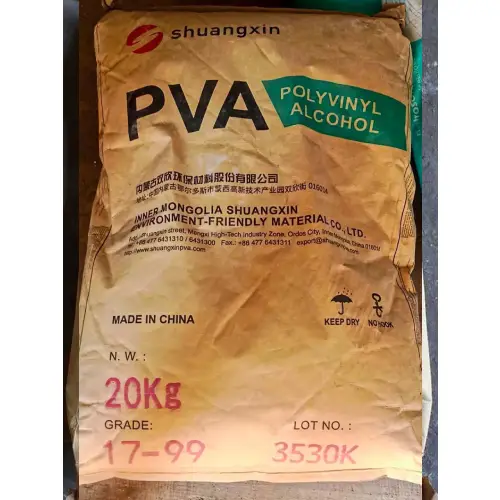
Polyvinyl alcohol (PVA) is produced through polymerization and alcoholysis of vinyl acetate. Its molecular formula is (CH2CHOH)m(CH2CHOCOCH3)n, and it is a stable, non-toxic, water-soluble polymer. The polyvinyl alcohol series encompasses various product types. Different types of polyvinyl alcohol are typically identified by four-digit numbers, where the first two digits multiplied by 100 represent the degree of polymerization, and the last two digits indicate the degree of alcoholysis.
The properties of polyvinyl alcohol (PVA) are primarily determined by its degree of polymerization and degree of alcoholysis. Fully alcoholyzed PVA is characterized by the presence of few residual hydrophobic acetate groups in its molecules, orderly molecular arrangement, a large number of hydroxyl groups, and strong hydrogen bonding. It is a crystalline polymer with high strength. Non-fully alcoholyzed PVA can be regarded as a macromolecule formed by the copolymerization of vinyl alcohol and vinyl acetate. Vinyl alcohol has strong hydrophilicity, while vinyl acetate is lipophilic. This amphiphilic structure determines that PVA macromolecules with low alcoholysis degree possess both properties of increasing water viscosity and reducing oil-water interfacial surface tension.
The viscosity of fully alcoholized PVA increases with time and gradually gelates, which can be restored after reheating. Adding sodium sulfate, potassium sulfate, ammonium sulfate, and borax can all produce a gel. Some alcoholized PVA solutions do not produce a gel.
In addition, the numerous weak non-covalent bonding forces, such as hydrogen bonds and van der Waals forces, present within the PVA system significantly affect its water solubility. The residual acetate groups of partially alcoholized PVA macromolecules can weaken hydrogen bonds between adjacent macromolecules and within the macromolecules, thereby improving the water solubility of PVA. However, the increase in acetate groups leads to a decrease in the critical temperature for phase separation, resulting in a gradual decrease in water solubility at high temperatures. For example, PVA with an alcoholysis degree of less than 60% is insoluble in water above 40℃.
PVA1799 is a polyvinyl alcohol polymer with a polymerization degree of 1700 and an alcoholysis degree of 99%. It is soluble in hot water above 95°C, and the aqueous solution has good adhesive properties and film-forming properties. An aqueous solution with a concentration greater than 10% will gel and freeze at room temperature, and will become thinner and regain fluidity at high temperatures.
Application:
Under external influence, PVA can undergo physical and chemical crosslinking. PVA prepared by the cyclic freeze-thaw method can exhibit rubber-like elasticity, and its mechanical properties are unmatched by most current hydrogels. PVA's strong tensile and compressive properties, as well as its good flexibility and ductility, make it an ideal candidate for flexible substrates, laying a good foundation for the development of wearable and implantable medical devices. In addition, PVA can also be used as a hydrogel substrate to construct hydrogel materials by combining with different types of polymers and nanoparticles, thereby obtaining superior mechanical and biological properties that match many biological tissues to meet application needs.
Under external influence, PVA can undergo physical and chemical crosslinking. PVA prepared by the cyclic freeze-thaw method can exhibit rubber-like elasticity, and its mechanical properties are unmatched by most current hydrogels. PVA's strong tensile and compressive properties, as well as its good flexibility and ductility, make it an ideal candidate for flexible substrates, laying a good foundation for the development of wearable and implantable medical devices. In addition, PVA can also be used as a hydrogel substrate to construct hydrogel materials by combining with different types of polymers and nanoparticles, thereby obtaining superior mechanical and biological properties that match many biological tissues to meet application needs.