

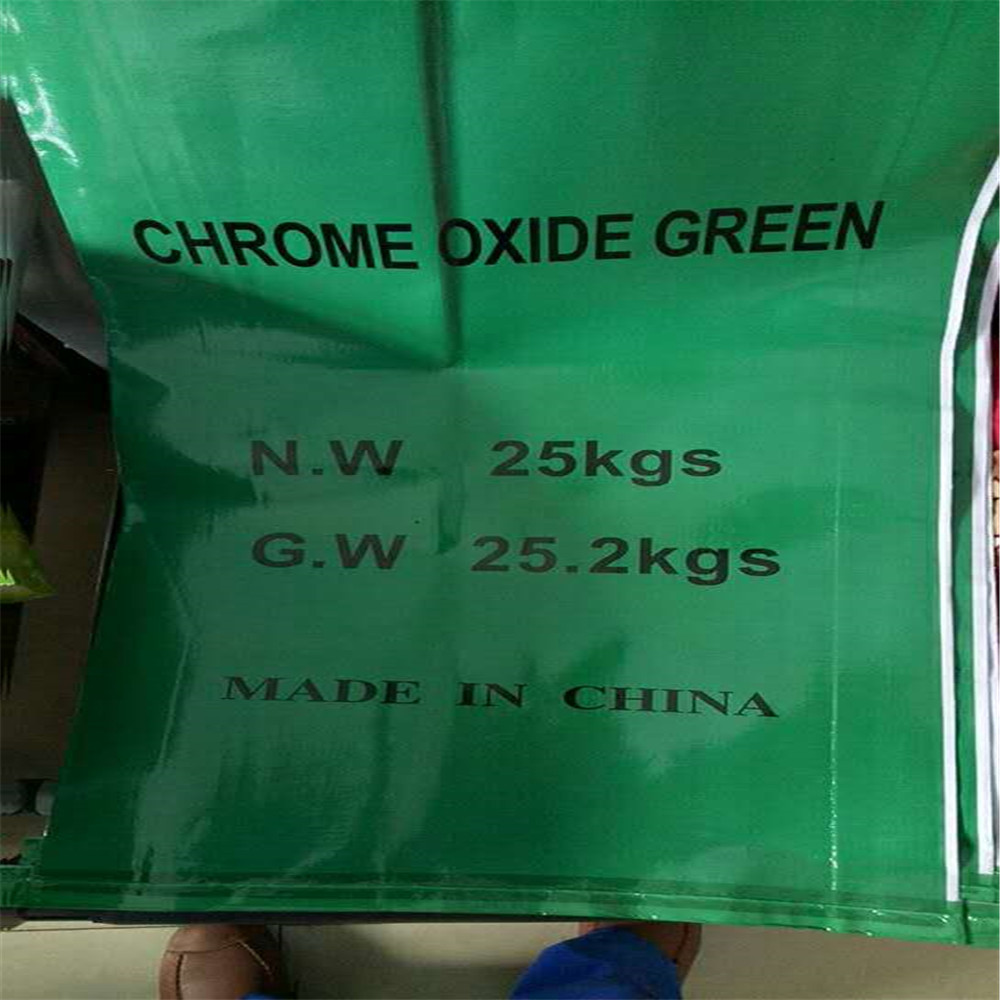
Chrome green, a high-grade green pigment, has a density of 5.21 g/cm³ and a melting point of 2266°C. It resists high-temperature corrosion and exhibits stable resistance to hydrogen sulfide. Widely used in ceramic glazes, weather-resistant coatings, banknote inks, and organic catalysis, it combines high opacity with magnetic properties. However, toxicity must be guarded against, and storage requires sealing to prevent moisture.
Chrome green, also known as chromium(III) oxide (Cr₂O₃), is named after its light green crystalline form. It appears as a green hexagonal crystalline powder with a density of 5.21 g/cm³, a melting point of approximately 2266±25°C, and a boiling point as high as 4000°C. Chrome green is soluble in hot alkali metal bromate solutions but poorly soluble in water, alcohol, acids, and alkalis. This pigment exhibits exceptional stability against light, atmospheric exposure, high temperatures, and corrosive gases such as sulfur dioxide and hydrogen sulfide. Additionally, it possesses outstanding hiding power, though it is toxic. By boiling with sulfuric acid, chromium(III) sulfate can be obtained. When mixed and heated with the oxides of many divalent metals at high temperatures, spinel-type compounds can be formed. Chrome green can be prepared through various methods, including the reduction reaction of potassium dichromate with sulfur and the thermal decomposition of chromium trioxide. It is a high-grade green pigment with extensive applications in fields such as enamel and ceramic glaze production, coloring artificial leather and building materials, catalysis in organic synthesis, and the manufacture of weather-resistant coatings, grinding materials, green polishing pastes, and specialized printing ink for banknotes.
Basic properties of chrome green
Chromium green is a light green crystalline powder with a density of 5.21g/cm ³, a melting point of approximately 2266 ℃, and a boiling point of 4000 ℃. Difficult to dissolve in water, acid, or alkali, but soluble in hot alkali metal bromate solutions. As an advanced green pigment, chrome green not only has excellent coverage, but also exhibits extremely high stability to light, atmosphere, high temperature, as well as corrosive gases such as sulfur dioxide and hydrogen sulfide. This makes it widely used in various fields, such as enamel and ceramic glaze manufacturing, coloring of artificial leather and building materials, catalysis of organic synthesis, as well as the manufacturing of sun resistant coatings, grinding materials, green polishing pastes, and specialized printing ink for banknotes.
Stability and Storage of Chromium Green
Chromium green exhibits stability in light, atmosphere, high temperature, and corrosive gases, with high coverage and magnetism. Although it is stable to light, atmospheric conditions, and high temperatures, its potential toxicity should be monitored. Chromium green remains stable when used and stored according to specifications, does not decompose, and has no known hazardous reactions. It is insoluble in water, difficult to dissolve in acid, but soluble in hot alkali metal bromate solutions. Chromium green exhibits excellent stability against light, atmosphere, high temperatures, and corrosive gases such as sulfur dioxide and hydrogen sulfide. In addition, it also has high covering power and magnetism, but it should be noted that it will turn brown when heated and return to green after cooling. The standard enthalpy of formation is -1128.4kJ/mol, and the standard free energy of formation is -1046.8kJ/mol. The crystal structure of chromium green is similar to Al2O3, with hexagonal lattice parameters a=0.495nm and c=1.3665nm, and the density varies depending on the manufacturing method.
Chromium green should be stored in a ventilated, dry, and sealed environment to prevent moisture.
Application Fields
Lead chromium green plays a key role in the paint industry and is the main coloring pigment for green paints. In addition, it is widely used in the paint and plastic industries, and its application range is quite similar to that of lead chrome yellow. However, due to the presence of chrome yellow and lead in lead chromium green, attention should be paid to its potential toxicity when using it. Meanwhile, due to the presence of iron blue and oxidizing agent lead chromate, dust may spontaneously ignite when encountering Mars, so extra caution is required during the drying and crushing process. Once lead chromium green burns, its green pigment properties will be completely lost, transforming into a deep brownish yellow substance. In addition, when making nitrocellulose paint, in order to avoid the burning risk during rolling, the process of mixing lead chrome green after slurry grinding is usually adopted instead of rolling directly with lead chrome green.
Lead chromium green has also been applied in the metallurgical field, and it is an important component of ceramics, refractory materials, pigment industry raw materials, and organic synthesis catalysts. Lead chromium green can also be used as an analytical reagent and catalyst. Lead chromium green is used as a coloring agent in adhesives and sealants to improve their wear resistance and corrosion resistance.
In addition, lead chromium green can also be used for coloring enamel, ceramics, synthetic leather, and building materials. It can also be used as an organic chemical synthesis catalyst and sun resistant coating. Lead chromium green has applications in ceramics, refractory materials, adhesives, and cosmetics, but cannot be used in oral and lip cosmetics. Lead chromium green is also suitable for coloring cosmetics, especially eye cosmetics. However, it should be noted that it should not be used in oral and lip cosmetics, and facial cosmetics and nail polish are also not recommended.
Chromium trioxide is one of the key components of the silver plating immersion solution, and the newly prepared chromium trioxide can also be used to prepare important raw materials such as chromium fluoride and chromium bromide.