

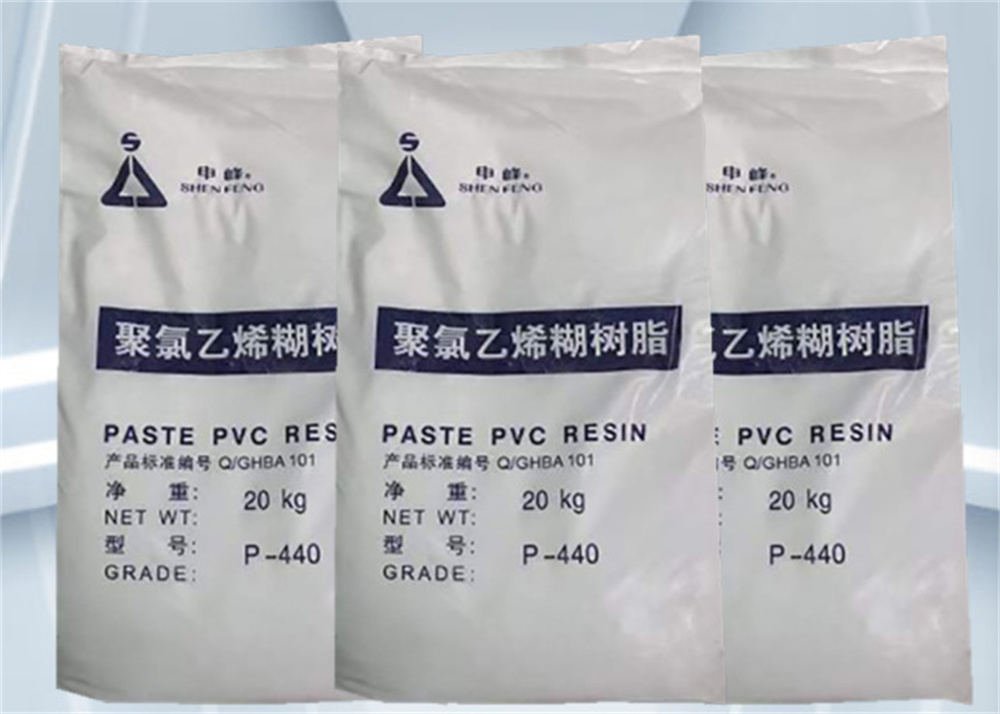
Polyvinyl chloride (PVC) paste resin, as the name suggests, is mainly used in the form of a paste for application. This paste is commonly referred to as plasticizing paste and is a unique liquid form of unprocessed PVC plastic. Paste PVC resin is usually prepared by lotion and micro suspension methods. Polyvinyl chloride paste resin, due to its fine particle size, has a texture similar to talcum powder and is non flowing. PVC paste resin is mixed with plasticizers and stirred to form a stable suspension, which is then made into PVC paste, also known as PVC plasticizer paste or PVC sol. It is in this form that people use to process it into final products. In the process of making paste, various fillers, diluents, heat stabilizers, foaming agents, and light stabilizers are added according to the needs of different products. The development of PVC paste resin industry provides a new type of liquid material that can be transformed into PVC products by heating alone. This liquid material has convenient configuration, stable performance, easy control, convenient use, excellent product performance, good chemical stability, certain mechanical strength, easy coloring, etc. Therefore, it is widely used in the production of artificial leather, vinyl toys, soft trademarks, wallpaper, paint coatings, foam plastics, etc. Compared with traditional suspension PVC resins, PVC paste resin has the following advantages: (1) Low cost processing equipment. (2) The mold is simple and cheap. (3) Can be made into special shapes. (4) Easy to foam. (5) The product has fewer heating cycles and can be produced in small quantities or multiple varieties.
1. The selection of paste PVC resin should first be based on the mechanical properties of the product to be processed, and the appropriate type of paste resin should be chosen.
PVC products with high degree of polymerization have higher mechanical strength, higher gel temperature and plasticization temperature, and higher product price. They are suitable for wear resistant layer, tensile resistant layer, hard surface layer and matting layer. PVC products with low degree of polymerization have low gel temperature, low plasticizing temperature, low price, but low mechanical strength. Secondly, the appropriate paste grade PVC resin should be selected based on the purpose, type, and processing form of the paste PVC resin. The viscosity of PVC paste resin products is an important selection index. For high foaming products, paste PVC resin products with relatively high viscosity and low gel temperature should be selected to control good foaming performance and uniform cell size distribution; Other products generally require a low viscosity of the paste to facilitate processing. For products with thicker layers, choosing resins with relatively higher viscosity does not have a significant impact on the apparent properties of the product; For products with thinner layers of paste, if the selected paste PVC resin has a higher viscosity, it will not only affect the uniformity and surface smoothness of the product, but also make the coating easy to peel off, and increase the amount of raw materials used.
2. The control of PVC paste resin processing formula has a significant impact on the product's purpose, quality, processing efficiency, and production cost.
It is necessary to make appropriate formula selection after clarifying the purpose of the product and selecting the appropriate paste PVC resin. Firstly, suitable blending agents should be selected according to the requirements of the product. The selection of additives should consider three factors: (1) meeting the performance requirements of the product, such as choosing cold resistant plasticizers for cold resistant products; For example, in the production of artificial leather, although lead salt stabilizers have good thermal stability, they are prone to precipitation and should not be used. Therefore, composite heat stabilizers such as calcium zinc that are not suitable for precipitation should be selected. (2) To meet the good processing requirements of the resin paste, if the viscosity of the plasticizing paste is too high to meet the requirements, a viscosity reducer can be added; For example, if the strength of artificial leather products is not very good, about 0.2% of gas-phase white carbon black can be added for reinforcement. (3) Reduce production costs while ensuring appropriate quality. If producing low-grade foam products with low requirements for foam cells, low-cost sodium bicarbonate foaming agent can be used instead of AC foaming agent; For example, in artificial leather, when heavy calcium (particle size less than 400 mesh), light calcium, and modified calcium carbonate fillers can all meet the requirements of the product, while heavy calcium only costs 250 yuan/ton, light calcium is over 1000 yuan/ton, and modified calcium is more expensive. Obviously, using heavy calcium is the most suitable. The preparation method of plasticizing paste is also important. Firstly, the design of the formula should meet the performance requirements of the product, and then consider meeting the good processing performance of plasticizing paste. On this basis, consider increasing the proportion of cheap additives as much as possible to achieve maximum economic benefits and competitive advantages in production. In the formulation, it is necessary to optimize the preparation according to the product requirements and processing requirements. The order and method of adding raw materials, the mixing of additives, and the pretreatment of raw materials not only have a significant impact on processing conditions, but also determine the quality of the final product performance. The same formula and different preparation methods produce different effects, and the quality of the products produced also varies greatly, which needs to be highly valued.
3. Control of processing conditions
After selecting the appropriate formula and processing method, the control of PVC paste products mainly depends on the gel process and plasticization process. Among them, the control of gel process of paste pvc resin has the greatest impact on the processing and performance of products, and is the most difficult to master. The gel process of the resin is related to the gel temperature and gel time of the resin. In the production process, if the gel temperature rises, the gelation speed will be accelerated, and the time required for gel can be shortened; On the contrary, gel can also be completed at a lower temperature and in a longer time, but the production efficiency is low. The gel temperature is related to the polymerization degree, particle size distribution and viscosity of the resin. Generally, there are the following empirical rules: under the same polymerization mode and similar viscosity, the gel temperature of the resin is mainly affected by the degree of polymerization, and the gel temperature increases about 3 ℃ for every 100 increase in the degree of polymerization; The paste viscosity also has a great influence on the gel temperature. The resin with a bimodal distribution or a wide unimodal distribution of the primary particle size has a lower paste viscosity, while the lower the paste viscosity, the higher the gel temperature of the resin. Therefore, the gel temperature of the resin is the result of the combined effect of polymerization degree and viscosity. In the actual production of in-process products, the gel process can be controlled within a certain range by adjusting the heating temperature and time, but the equipment efficiency, equipment capacity and stability of the production process should also be comprehensively considered. This adjustment is limited, so the pvc paste resin product model should be properly selected when formulating.
4. Application field:
Artificial leather industry: overall market supply and demand balance. However, due to the development of PU leather, the demand for synthetic leather in major paste pvc resin consumption areas such as Wenzhou is somewhat constrained. The competition between PU leather and synthetic leather is quite fierce. Floor leather industry: Affected by the shrinking demand for floor leather, the demand for adhesive resin in this industry has been declining year by year in recent years.
Glove material industry: There is a high demand, mainly for imports, and it belongs to material processing. In recent years, some domestic manufacturers have entered the glove material industry, not only partially replacing imports, but also increasing sales year by year. Due to the fact that the domestic medical glove market has not yet opened up and has not formed a fixed consumer group, there is still significant development space for medical gloves.
Wallpaper industry: With the continuous improvement of people's living standards, the development space of wallpaper, especially high-end decorative wallpaper, is constantly expanding. The demand for wallpaper in hotels, entertainment venues, and some household decorations is constantly expanding.
Toy industry: The market demand for adhesive resin is relatively stable.
Immersion molding industry: The demand for paste resin is increasing year by year. Advanced immersion molding is mainly used in electric handles, medical devices, and other applications.
Conveyor belt industry: stable demand but poor profitability of downstream enterprises.
Automotive decorative materials: With the rapid development of China's automotive industry, the demand for adhesive resin in automotive decorative materials is also constantly expanding.