

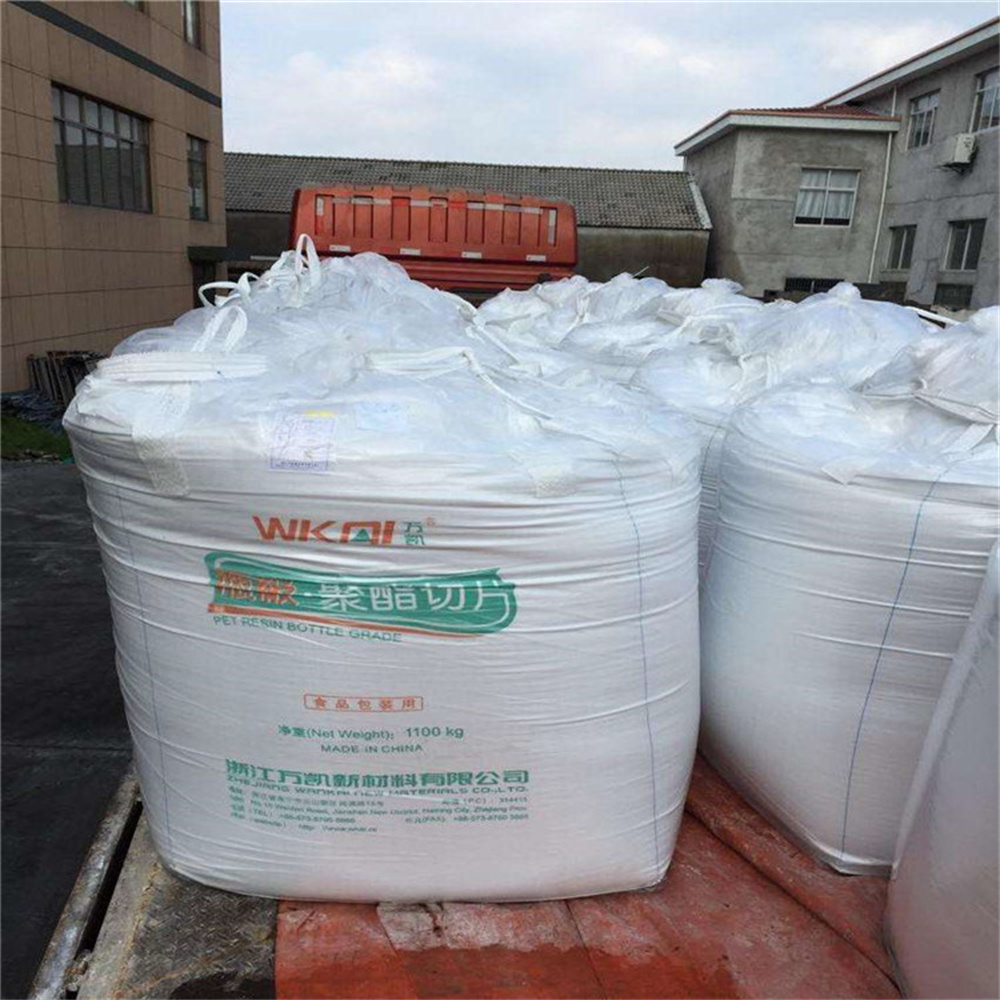
Basic Information on Polyester Bottle Chips
Polyethylene Terephthalate bottle flakes are a synthetic polymer made by polymerizing and esterifying purified terephthalic acid (PTA) and ethylene glycol (MEG). PET resin have a uniform crystal structure, which helps to improve their physical strength and transparency. Due to their advantages of low cost, lightweight, high transparency, and recyclability, polyester bottle flakes are widely used in the packaging industry, mainly for containers such as beverage bottles, food packaging, cosmetic bottles, and pharmaceutical bottles.
Polyester bottle flakes are a product form of polyethylene terephthalate (PET), which is made into thin sheets through processing technology to obtain polyester bottle flakes. Polyester includes polyester fibers (polyester), polyester bottle sheets, and polyester films. In the domestic market, polyester fibers account for over 75% of polyester demand, including polyester filament and staple fibers, mainly used in the textile industry; Polyester bottle flakes account for about 20% of the demand for polyester, mainly used in bottle packaging and sheet materials. Among them, bottle packaging such as soft drink bottles and oil bottles account for about 70% of the demand for polyester bottle flakes, while sheet materials and other uses account for about 30%.
Supply and demand situation of global polyester bottle chip market
supply
From 2013 to 2023, the total global production capacity of Polyethylene Terephthalate Resin increased significantly, from 24.103 million tons to 34.565 million tons. During this period, the growth rate of production capacity was relatively fast from 2013 to 2015, with an average annual growth rate of 6.03%, and the increase mainly came from China, the Middle East, Africa, and South America. However, in 2016, the global economy was still undergoing a deep adjustment, with a slowdown in global economic growth and energy and chemical products basically in a bottom recovery period, resulting in negative growth in polyester bottle production capacity in 2016. From 2013 to 2023, the global utilization rate of bottle tablet production capacity remained at 77% -83%, indicating that although production capacity continues to expand, there has been little change in capacity utilization rate, and there has been no significant reduction or shutdown overall. Mainly because the global consumption of bottle flakes has been increasing, this trend supports the capacity utilization rate to remain at around 80%.
As of the end of November 2023, CCF data shows that the global production and consumption of polyester bottle flakes in 2023 are estimated to be 30.18 million tons and 31.76 million tons, respectively, with most of the excess consumption being accumulated inventory in early 2022. Compared with previous years, the global capacity utilization rate of bottle flakes in 2023 is 76.6%, which is at a relatively low level. The reason is that due to the impact of rising energy, transportation, and labor costs, the average capacity utilization rate in some overseas regions is low, especially in the European Union, where most facilities operate at low load for a long time, and the production of new capacity in the United States is delayed.
From the distribution of global Pet Resin Bottle Grade supply, in 2023, the global production capacity of polyester bottle chips is mainly concentrated in Asia, North America, and Europe, accounting for 57.8%, 15.1%, and 11.8% of the production capacity respectively. These three regions account for about 85% of the global production capacity. Asia has been the fastest-growing region in the polyester bottle chip industry in the past decade; The European and American regions are the traditional origins and production areas of polyester bottle chips. However, with the transformation of industrial patterns and consumption regions, there has been no significant increase in consumption. Therefore, there are not many new production capacity in the European and American regions, and some old production capacity is gradually being phased out. From the perspective of the distribution of polyester bottle chip production capacity among countries, the top four countries in terms of production capacity in 2022 are China, the United States, India, and South Korea, accounting for approximately 55% of global production capacity.
With the global production capacity of polyester bottle flakes increasing year by year, China's share of global production capacity is also continuously increasing, rising from around 27% in 2013 to around 38% in 2023. In 2023, the global production capacity of polyester bottle flakes will be concentrated in China, India, and Vietnam. In addition, in 2024 and beyond, the global new capacity is concentrated in China, Türkiye, Brunei and other places, and China's new capacity accounts for about 79% of the global new capacity.
consumption
Unlike the high growth rate of global polyester bottle production capacity, according to data, the global consumption of polyester bottle remains at a low growth rate. The global consumption of polyester bottle flakes in 2023 is mainly concentrated in China, North America, and Western Europe, accounting for 58% of the total global consumption. Specifically, in 2023, the consumption of polyester bottle flakes is mainly concentrated in mineral water bottles, carbonated beverage bottles, packaging, and film, accounting for 73% of the total consumption.
Unlike polyester fibers, the production capacity distribution of polyester bottle flakes is relatively dispersed, mainly influenced by population base, economic level, and consumption habits. Since 2012, the largest consumption of polyester bottle flakes worldwide has shifted from carbonated soft drink bottles to mineral water bottles, with mineral water bottles accounting for 35% of the total global consumption of polyester bottle flakes in 2023. This change is related to a shift in consumer attitudes, with a relatively rapid increase in consumption of packaged water and healthy beverages, while consumption of carbonated beverages has declined since reaching its peak in 2019.
trade flow
From the perspective of global trade flow of polyester bottle flakes, Asia is the main net export region, especially China, as the world's largest net export country, has shown a clear trend of rapid growth in export volume. Northeast Asia, South Asia, and Southeast Asia remain the net export regions of the Asian region.
In addition, North America was a net exporter before 2014, but has become a net importer since 2014, and the net import volume has been increasing year by year. The net inflow of polyester bottle flakes is mainly concentrated in the Americas, Europe, the Middle East, and Africa. In recent years, there has been a significant increase in net imports in the Americas, while net imports in Europe, the Middle East, and Africa have shown small-scale fluctuations.
In 2023, according to data, the Americas account for approximately 19% of global bottle tablet production capacity, mainly from the United States, and are also one of the main consumer regions for bottle tablets worldwide. Due to the high cost of polyester at the end of 2022, some bottle chip units in the Americas experienced production cuts, and downstream customers turned to purchasing imported goods. The import peak arrived earlier, but it was difficult for the United States and South American countries to quickly digest it in the short term, resulting in a decrease in import volume; With the peak consumption season in the later stage, supply and demand gradually improve. According to CCF's data, overall, the Americas' share of global imports will drop to around 26% in 2023. Europe is one of the main consumer regions for bottle flakes. Due to the lack of new production capacity in recent years, the global production capacity has declined to around 11%, and most facilities have experienced production cuts or shutdowns, resulting in high demand for bottle flake imports. Overall, Europe will account for about 36% of global imports in 2023, with a slight year-on-year increase,